
Companies that use accrual accounting and find themselves in a position where one accounting period transitions to the next must see if any open transactions exist. However, in practice, revenues might be earned in one period, and the corresponding costs are expensed in another period. Also, cash might not be paid or earned in the same period as the expenses or incomes are incurred. To deal with the mismatches between cash and transactions, deferred or accrued accounts are created to record the cash payments or actual transactions.
Create a free account to unlock this Template
Adjusting entries, also called adjusting journal entries, are journal entries made at the end of a period to correct accounts before the financial statements are prepared. Adjusting entries are most commonly used in accordance with the matching principle to match revenue and expenses in the period in which they occur. It is impossible to provide a complete set of examples that address every variation in every situation since there are hundreds of such Adjusting Entries. The article will discuss a series of examples to understand better the necessity of adjusting entries.
Salvage Value – A Complete Guide for Businesses

Adjusting entries requires updates to specific account types at the end of the period. Not all accounts require updates, only those not naturally triggered by an original source document. There are two main types adjusting entries examples of adjusting entries that we explore further, deferrals and accruals. The required adjusting entries depend on what types of transactions the company has, but there are some common types of adjusting entries.
Prepaid expenses adjusting entries
Some common examples of prepaid expenses are supplies, depreciation, insurance, and rent. When the exact value of an item cannot be easily identified, accountants must make estimates, which are also considered adjusting journal entries. Taking into account the estimates for non-cash items, a company can better track all of its revenues and expenses, and the financial statements reflect a more accurate financial picture of the company. Similar to an accrual or deferral entry, an adjusting journal entry also consists of an income statement account, which can be a revenue or expense, and a balance sheet account, which can be an asset or liability.
Unearned revenues are also recorded because these consist of income received from customers, but no goods or services have been provided to them. In this sense, the company owes the customers a good or service and must record the liability in the current period until the goods or services are provided. Making adjusting entries is a way to stick to the matching principle—a principle in accounting that says expenses should be recorded in the same accounting period as revenue related to that expense. A pest control company is contracted to provide services to an organization for a duration of 12 months, commencing in January 2024.
For example, let’s assume that in December you bill a client for $1000 worth of service. They then pay you in January or February – after the previous accounting period has finished. The entry for insurance reflects six months’ expenses, which have been paid, but coverage of only one month could have been used by June end. For example, salaries and wages are among the most common types of accrued expenses.
- It’s important for businesses to adjust for all these items so that their balance sheets are correctly valued and income statement activity is reflected accurately and in the correct accounting period.
- Depreciation Expense increases (debit) and Accumulated Depreciation, Equipment, increases (credit).
- Once you have journalized all of your adjusting entries, the next step is posting the entries to your ledger.
- For example, accounting adjustments are sometimes made to correct an error or to reconcile an item found during the accounting close, such as a bank charge uncovered as part of the cash account reconciliation.
For example, a company performs landscaping services in the amount of $1,500. At the period end, the company would record the following adjusting entry. After the first month, the company records an adjusting entry for the rent used. The following entries show initial payment for https://www.bookstime.com/ four months of rent and the adjusting entry for one month’s usage. For example, a company pays $4,500 for an insurance policy covering six months. It is the end of the first month and the company needs to record an adjusting entry to recognize the insurance used during the month.
Adjusting Entry for Accrued Expense
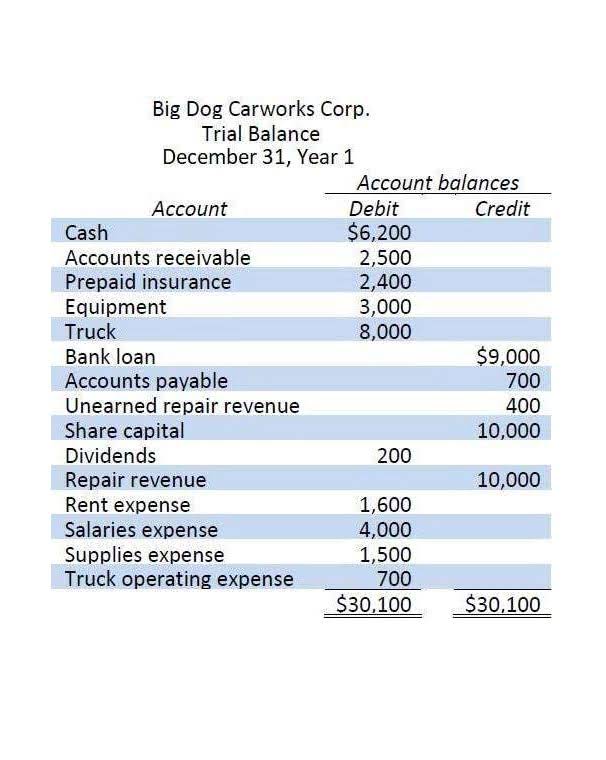
Expenses are transactions that are not immediately recognized in the correct accounting period. Depreciation is the process of allocating the cost of an asset to expense over its useful life. These entries are made at the end of the business’s accounting period. A company’s financial position must be accurately reflected in its financial statements. Once you complete your adjusting journal entries, remember to run an adjusted trial balance, which is used to create closing entries.